
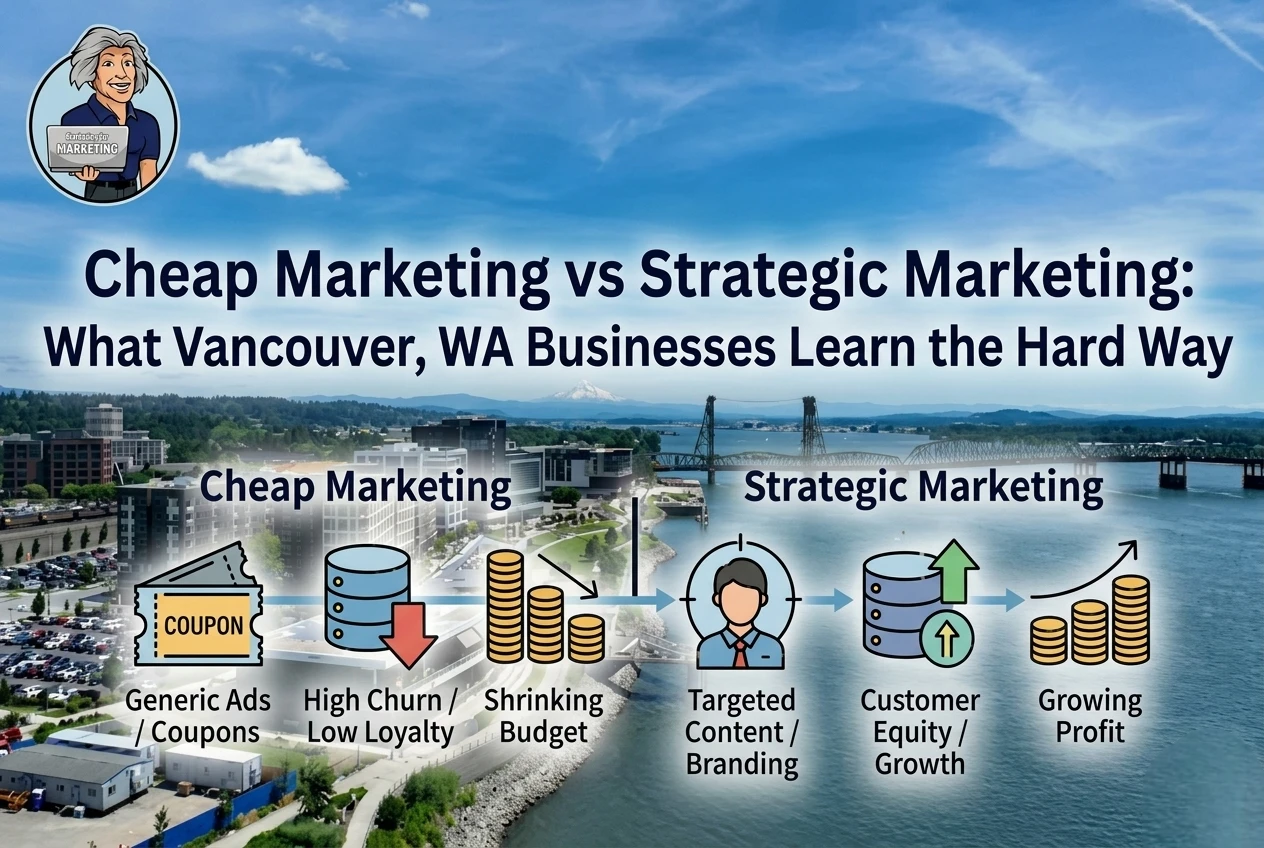
Cheap marketing buys you attention today. Strategic marketing builds an asset that brings you customers for years. For most Vancouver, WA contractors and service businesses, the hard lesson is the same: the cheapest option almost always ends up costing the most over time.
Cheap marketing usually means quick, low-commitment tactics such as one-off ad bursts, $99 logo packages, bargain lead lists, or rented exposure that vanishes the moment you stop paying. It can produce fast clicks, but the results disappear when the budget does, and you never actually own anything. Strategic marketing is a coordinated plan built around your market, website, Google Business Profile, reviews, and reputation. It takes longer to ramp up, but it compounds, lowers your cost per lead over time, and positions you ahead of competitors who keep renting attention.
The short-term versus long-term difference is the core of it. Paid ads can win in the first three to six months because they deliver immediate traffic, while organic and reputation-driven marketing typically surpasses paid ROI within 9 to 12 months and continues to grow. The smartest local businesses do not pick one and abandon the other. They build their own foundation first, then layer paid campaigns on top for speed when they need it.
TLDR / Key Takeaways
- The cost gap is dramatic. In the trades, industry data show roughly $19.90 returned per $1 spent on SEO versus $4.40 per $1 spent on paid ads, a close to 5x difference in return on spend.
- Speed favors paid, value favors strategy. PPC delivers leads in days and reliably returns about $2 for every $1 invested, but strong SEO programs commonly report 500% to 1,300% ROI after a year or more.
- Lead quality differs. Inbound SEO leads close at about 14.6% versus 1.7% for outbound tactics like cold calls, roughly an 8.6x close rate advantage.
- Ownership matters. Paid ads are rented real estate that stop the instant you stop paying. SEO, your website, and your reviews are assets you own and keep.
- Local intent is huge. About 46% of all Google searches have local intent, and 78% of local mobile searches lead to an offline purchase within 24 hours.
- Reputation drives leads. Businesses with 50 or more Google reviews earn 266% more leads than those with fewer than 10.
- Best practice: build the owned foundation first, then use paid ads strategically for seasonal pushes and fast demand.
How Each Approach Actually Works
Cheap marketing treats every dollar as a transaction. You pay, you get clicks or impressions, and the meter resets to zero when the campaign ends. There is nothing wrong with paid traffic itself, the problem is using it as your only engine. When a Vancouver remodeler spends $3,000 a month on ads and nothing else, month 13 looks exactly like month one. The cost per lead never drops because there is no compounding asset underneath.
Strategic marketing builds layers that reinforce each other. A fast, well structured website ranks in search. An optimized Google Business Profile captures the near me searches that have grown roughly 150% faster than general searches. Reviews build trust that improves both ranking and conversion. Content answers the questions your customers ask before they call. Each layer makes the others more effective, and the whole system keeps producing leads even on the months you spend less.
The Real Cost Comparison
Here is how the two approaches typically play out for a local contractor over a year. The numbers below reflect common SMB ranges and reported industry benchmarks, not a guarantee for any single business.
| Factor | Cheap / Tactical Marketing | Strategic Marketing |
| Typical monthly cost | $300 to $1,500 (ad spend, gig services) | $1,500 to $5,000 (integrated program) |
| Time to first leads | Days | 60 to 120 days for momentum |
| Return on spend | Roughly $2 to $4.40 per $1 | Roughly $7.48 median, often $10+ at maturity |
| What you own afterward | Nothing, results stop with payment | Website, rankings, reviews, content |
| Lead quality / close rate | Lower, often price shoppers | Higher, about 14.6% inbound close rate |
| Cost per lead over time | Flat or rising | Falls as assets compound |
| Best use | Fast bursts, seasonal demand | Long term growth and positioning |
The pattern is consistent across reputable studies. For a $100,000 annual budget, SEO can generate roughly $51,724 in revenue versus $23,275 from PPC, more than double the return from the same spend. The catch is patience. Paid ads pay you back this week, while strategic marketing pays you back this year and the next.
Where Each One Actually Wins
Neither approach is wrong. They solve different problems, and matching the tool to the job is the discipline most struggling businesses skip.
| Situation | Better Choice | Why |
| Brand new, need calls this week | Paid ads | Immediate visibility while assets are being built |
| Seasonal rush (storm season, summer HVAC) | Paid ads | Capture short-term demand spikes |
| Launching a new service area | Paid plus local SEO | Speed now, durability later |
| Building long term lead flow | Strategic SEO and reviews | Compounds and lowers the cost per lead |
| Competing on reputation and trust | Strategic | 87% of consumers use Google to evaluate local businesses |
| Tight budget, want lasting value | Strategic foundation first | You keep the asset |

A Vancouver Scenario Worth Studying
Consider two fictional but realistic Vancouver, WA contractors competing in the same trade.
Contractor A chases cheap. He buys a discount lead service, runs sporadic ad bursts, and never invests in his website or reviews. In peak season the phone rings. In the slow months it goes quiet, and his cost per lead never improves. After two years he has spent tens of thousands and owns nothing but a folder of expired campaigns.
Contractor B builds strategically. The first 90 days feel slow while the website, Google Business Profile, and review system get built. By month four she starts ranking in the local pack that captures around 44% of clicks for local queries. She still runs paid ads, but now they amplify a foundation instead of carrying everything. By year two her cost per lead has dropped, referrals compound, and her marketing keeps producing even when she eases off spending. Same market, same trade, very different outcome.
Strategic Positioning: The Insight Most Miss
The deepest difference is not cost or speed, it is what you are building. Cheap marketing rents attention. Strategic marketing builds equity in your market. When you own the top of local search, a strong reputation, and a website that converts, you become the default choice in your area. Competitors who only rent attention are forced to keep outbidding each other for the same clicks while your cost of acquisition keeps falling. That is the positioning advantage that quietly decides who dominates a local market over five years.
Ready to Stop Renting and Start Owning?
If your marketing stops working the moment you stop paying, you do not have a strategy, you have an expense. Genius Marketing helps Vancouver, WA contractors and service businesses replace scattered, cheap tactics with a coordinated plan that compounds, lowers cost per lead, and turns your online presence into an asset you actually own.
Call (360) 519-5100 or email [email protected] to get a clear, honest read on where your marketing dollars are leaking and what a strategic foundation would do for your lead flow.
The contractors who win their market are not the ones who spend the most. They are the ones who stop guessing and start building. Let’s build yours.
Frequently Asked Questions
Is cheap marketing ever the right choice for a contractor?
Yes, for short bursts. Paid ads make sense for seasonal demand, a new service launch, or filling the schedule fast. The mistake is relying on cheap tactics as your only engine, because the results vanish the moment the spending stops.
How long before strategic marketing pays off?
Most local businesses see real momentum in 60 to 120 days and a clear ROI advantage by 9 to 12 months. After that point it typically outperforms paid ads and keeps compounding while your cost per lead falls.
Why do my cheap leads convert so poorly?
Bargain lead lists and broad ad clicks often attract price shoppers, not ready buyers. Inbound leads from search and reputation close at roughly 14.6% versus 1.7% for cold outbound, because those customers already trust you before they call.
Do reviews really affect how many jobs I get?
Significantly. Businesses with 50 or more Google reviews earn 266% more leads than those with fewer than 10, and most consumers check Google before choosing a local contractor, even after a referral.
What should a Vancouver, WA business invest in first?
Build the owned foundation first: a fast website, an optimized Google Business Profile, and a steady review system. Layer paid ads on top for speed once that base is capturing the 46% of searches with local intent in your area.
Sources
- SEO ROI Statistics for 2026, SEOProfy
- Average ROI from SEO vs Paid Ads in the Trades, CI Web Group
- 35 SEO ROI Statistics for 2026, theStacc
- SEO vs Paid Ads: Which Gives Better ROI, Single Grain
- Local SEO Statistics for 2025, OnTheMap
- 35+ Local SEO Statistics for 2026, BrightLocal
- SEO vs PPC in 2025: Trust and ROI, AboveA