
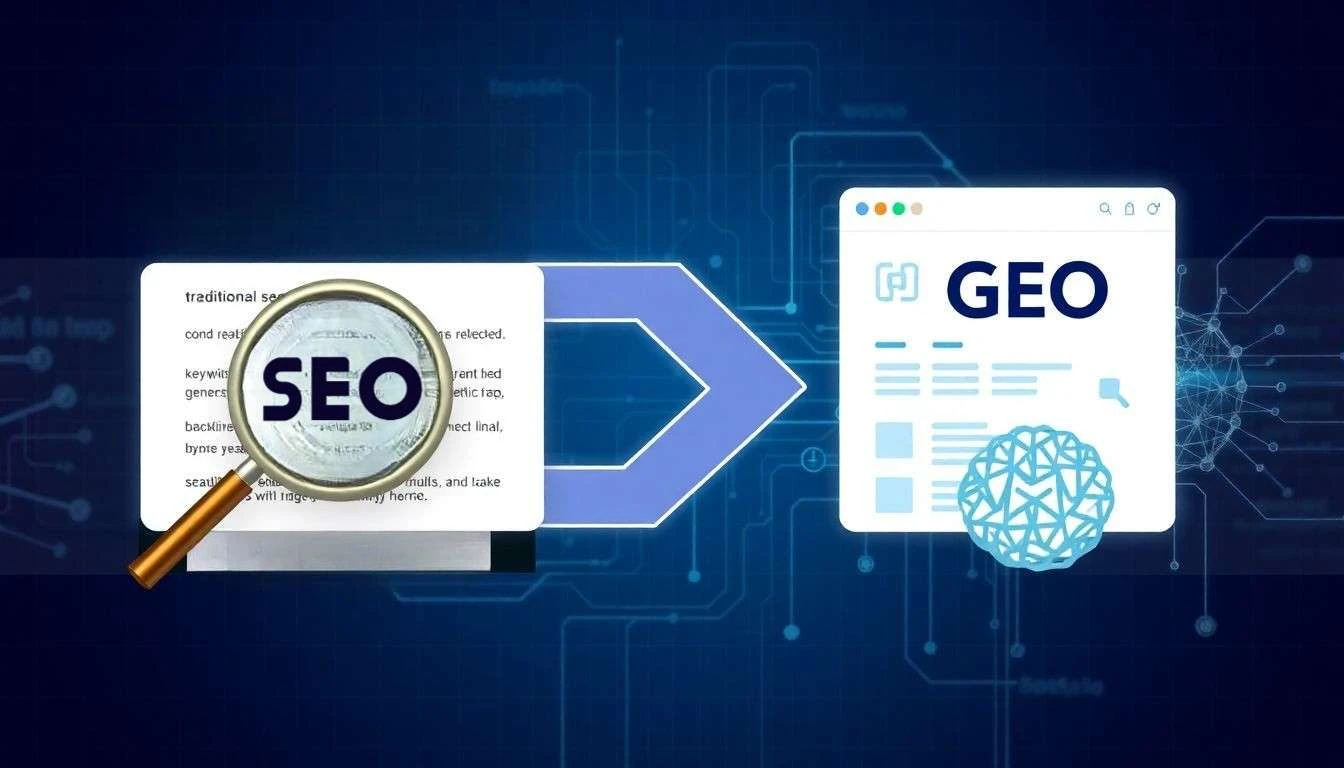
Traditional Search Engine Optimization (SEO) remains the most effective method for driving local traffic through map listings and standard search results, while Generative Engine Optimization (GEO) is the superior choice for visibility within AI-driven responses. For most local companies, the best approach is not to choose one over the other, but to understand how they serve different user behaviors. Traditional SEO helps a business show up when someone searches for a specific service nearby, such as a plumber or a lawyer. GEO ensures that when a user asks an AI assistant for a recommendation based on specific criteria, that business is the one the AI mentions by name.
This guide provides an objective look at both strategies to help local business owners decide where to allocate their resources. By examining technical requirements, user intent, and measurable outcomes, it becomes clear how these two disciplines function in the current digital environment. The information and data provided here are based on an analysis of local market trends and digital performance metrics in the Pacific Northwest. Here is a complete SEO guide for organic traffic.
Defining Traditional Search Engine Optimization For Local Markets
Traditional SEO focuses on improving a website to rank higher in organic search results. It relies on established factors such as keyword density, site speed, and the quality of incoming links from reputable websites. For a local business, this usually involves optimizing a Google Business Profile and ensuring the website mentions specific geographic areas.
The primary goal is to capture users who search for specific terms. If a resident in Vancouver searches for “auto repair,” the search engine looks for websites that demonstrate the highest authority and relevance for that specific term. According to data from the Vancouver Business Journal, local commerce relies heavily on these digital discovery channels as more consumers shift from physical directories toward mobile search.
Core Elements Of Traditional SEO
Traditional strategies prioritize technical health and content structure. This includes:
- Local Citations: Ensuring the business name, address, and phone number are consistent across the internet.
- Backlink Profile: Gaining links from local organizations, news outlets, and the chamber of commerce sites.
- On-Page Optimization: Using headers, meta descriptions, and title tags that include local keywords.
- User Experience: Maintaining fast load times and a layout that works well on smartphones.
The Rise Of Generative Engine Optimization
Generative Engine Optimization is a relatively new field that focuses on how AI models such as ChatGPT, Perplexity, and Google Gemini process and present information. Instead of a list of blue links, these engines provide a conversational answer. For a business to be included in that answer, its content must be structured in a way that AI models find easy to cite.
GEO moves away from keyword matching and toward intent satisfaction. If a user asks, “Which coffee shop in downtown Vancouver has the best workspace for remote students?” the AI will look for specific mentions of Wi-Fi quality, seating types, and noise levels. It does not just look for the words “coffee shop.”
Key Differences In Technical Approach
While Traditional SEO seeks to rank for a term, GEO seeks to be the cited source for a factual claim. This requires a shift in how information is presented on a website. AI models prefer direct, authoritative statements and structured data formats such as JSON-LD schemas.
Comparing The Two Strategies For Local Visibility
To understand which strategy fits a specific business, it helps to compare its primary characteristics side by side.
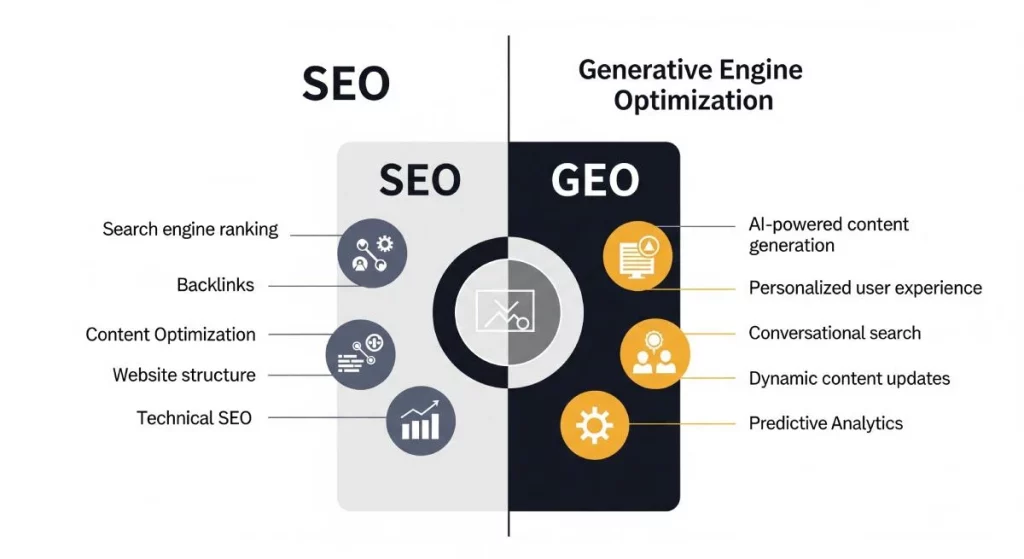
| Feature | Traditional SEO | Generative Engine Optimization (GEO) |
|---|---|---|
| Primary Goal | Ranking in the top 10 results | Being cited in an AI summary |
| Content Format | Long-form articles and service pages | Direct answers and structured lists |
| Traffic Source | Search engine result clicks | Clicks from AI citations and mentions |
| Technical Priority | Site speed and mobile optimization | Schema markup and factual clarity |
| User Intent | General research and discovery | Specific problem-solving and advice |
| Success Metric | Organic impressions and clicks | Brand mentions in AI chat sessions |
Market Realities In Vancouver, Washington
The digital landscape in Clark County shows that user behavior is shifting toward conversational queries. Local data from Clark College indicates that younger users are increasingly using AI tools to find local services rather than scrolling through pages of local seo guide search results. This data suggests that businesses targeting a younger or tech-savvy audience should prioritize GEO elements sooner rather than later.
However, the City of Vancouver still sees a massive volume of traditional searches for essential services. For emergency needs, like a broken furnace or a sudden legal issue, users still turn to Google Maps and traditional search results because they need an immediate list of options with ratings and contact buttons.
Bonus Tip: Use “Frequently Asked Questions” sections on every service page. Phrase the questions exactly as a person would speak them into a voice assistant. This helps both Traditional SEO for “people also ask” boxes and GEO for direct AI citations.
Factors To Consider Before Making A Decision
Choosing where to invest requires assessing a business’s current state and long-term goals.
Nature Of The Industry
Service-based businesses such as HVAC, plumbing, and towing rely heavily on “near me” searches in Traditional SEO. Knowledge-based businesses such as consulting, real estate, and niche retail benefit more from GEO because users often ask AI engines for complex advice or comparisons before making a purchase.
Current Website Authority
If a website already has high authority and ranks well for local terms, digital strategy experts suggest focusing on GEO to protect that lead as AI search grows. If a website is new or lacks visibility, Traditional SEO is the necessary first step to build the foundation that AI models eventually use to verify the business’s existence.
Content Production Capability
GEO requires highly factual content that is easy for a machine to parse. If a business cannot produce clear, authoritative content that answers specific questions, Traditional SEO might be a more straightforward starting point. Traditional methods can sometimes succeed with simpler, keyword-focused pages, whereas AI engines will ignore vague or “fluffy” content.
Integrating Both For A Complete Strategy
The most effective local businesses do not choose between these two. They leverage the technical foundations of Traditional SEO to support GEO’s visibility needs. By using structured data and clear language, a business can satisfy both a Google bot and a ChatGPT crawler.
Bonus Tip: Focus on “Authoritativeness.” List the credentials of the people writing the content on the website. AI engines prioritize information from verified experts. Traditional search engines also use this as a ranking signal, making it a win for both strategies.
Strategic Planning Before Making A Decision
- Target Audience Behavior: Determine whether customers are likely to use AI assistants or prefer traditional search engines.
- Competition Levels: Analyze whether competitors are already dominating the local map pack or are being cited by AI engines.
- Budget Allocation: Decide whether to focus on long-term authority (Traditional) or on capturing the emerging AI-user market (GEO).
- Technical Readiness: Assess if the website can handle the advanced schema implementation required for GEO.
- Local Relevance: Ensure the business has a physical presence and local citations that verify its location to both bots and AI.
Summary Of Local Search Options
Selecting the right path involves balancing immediate needs with future-proofing. Traditional SEO remains the backbone of local discovery, providing the map listings and organic rankings that drive daily phone calls and foot traffic. GEO represents the next evolution, focusing on the conversational and analytical ways people now seek information.
For a business in Vancouver, Washington, maintaining a strong local presence requires a website that is technically sound for search bots and intelligible to AI models. Evaluate the current digital footprint and determine whether the content provides sufficient direct value to serve as the AI’s sole answer for a potential customer.
Contact Information For Local Support
If a business needs a clear assessment of its digital presence, reaching out to local professionals can provide clarity. Genius Marketing provides analysis of search trends specifically for the Vancouver, Washington area. For questions regarding digital strategy or local visibility, contact the office at (360) 519-5100 or email [email protected] to discuss specific business goals.
Frequent Questions About Local Search Trends
Does Traditional SEO Still Work For New Businesses?
Yes. Traditional SEO is often the fastest way for a new business to show up in a specific city. By optimizing a Google Business Profile and getting local reviews, a new company can appear in local map results even before its website has high authority.
How Long Does It Take To See Results From GEO?
GEO results are often tied to how frequently an AI model updates its training data or accesses live search. While some engines, such as Perplexity, use live data, others may take longer to recognize a business as a leading authority in its field.
Is Schema Markup Necessary For Both Strategies?
While Traditional SEO can function without it, schema markup is a major advantage for both. It helps search engines understand a business’s details and makes it significantly easier for AI models to cite the business accurately in conversational responses.
Will AI Search Replace Google Maps?
It is unlikely to replace it entirely in the near future. Google Maps provides a functional utility for navigation and immediate contact that conversational AI is still refining. However, AI will continue to influence how those map results are selected and presented to the user.
Can A Business Manage Both Without A Large Team?
It is possible by focusing on quality over quantity. Instead of writing dozens of keyword-stuffed blog posts, a business should focus on five to ten comprehensive pages that answer the most common customer questions with factual precision.
Sources
- Vancouver Business Journal – A leading source for business news and economic trends in Vancouver and Southwest Washington.
- City of Vancouver – The official government website providing data on local infrastructure and business regulations.
- Clark College – A regional educational institution that tracks local workforce and technology trends.
- Clark County Washington – Government site offering demographic and economic statistics for the surrounding region.