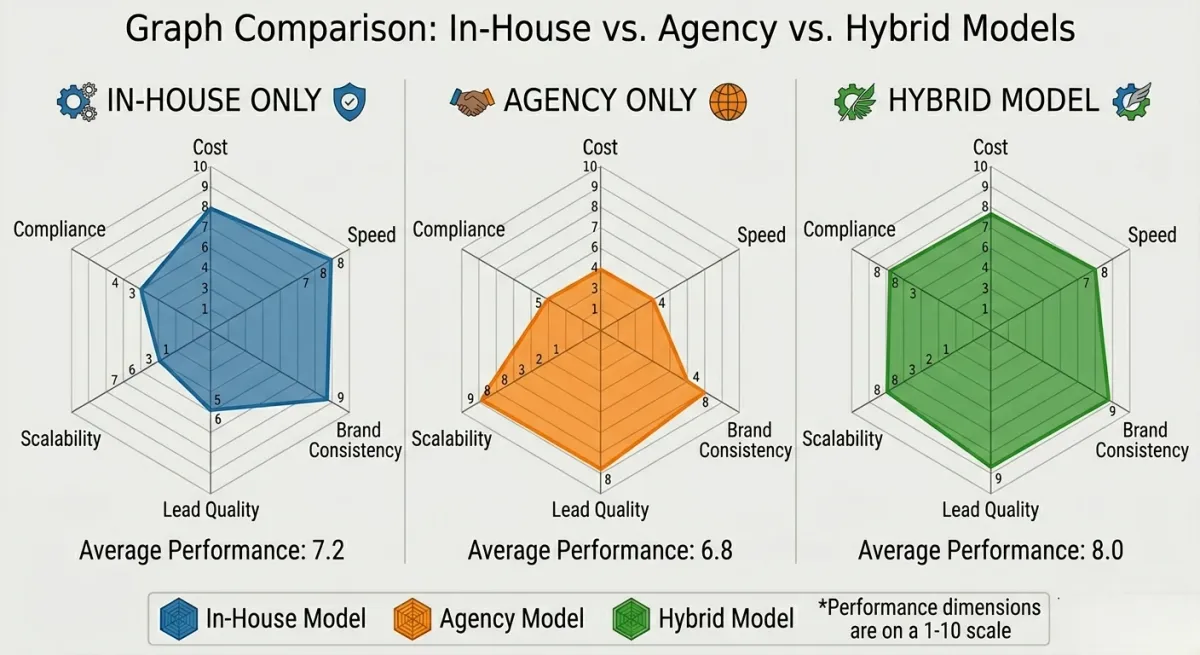
If you run a law firm and you’re debating whether to build an in-house marketing team or hire an agency, here is the short answer: most small to mid-sized law firms get better results, faster and at lower total cost, by working with a specialized marketing agency. In-house teams make sense only when your firm has reached a scale at which a dedicated, multidisciplinary team is fully justified.
In-house marketing means hiring one or more employees directly to manage your SEO, paid ads, content, social media, and branding. You own the strategy, but you also own the overhead. Agency marketing means outsourcing those same functions to a firm that already has the specialists, tools, and processes in place. You pay a retainer and get a full team without the payroll burden.
In the short term, agencies get campaigns live faster. Long-term, in-house teams can develop deeper brand voice familiarity. But for most law firms outside the AmLaw 200, the agency model consistently delivers higher ROI with lower risk.
What These Two Terms Actually Mean for Your Law Firm
Before comparing them, it is worth being precise about what each model actually involves. Many attorneys walk into this decision with a vague understanding of both options, and that ambiguity leads to expensive mistakes.
In-House Marketing means you directly employ the people responsible for growing your firm’s visibility and client pipeline. This could be a single marketing coordinator handling everything, or a full team with specialized roles covering SEO, paid advertising, content creation, graphic design, and social media. These employees are on your payroll, sit inside your firm, attend your meetings, and work exclusively on your brand. You have daily control over their work, but you also absorb the full cost of their salaries, benefits, tools, and ongoing training. When they leave, that institutional knowledge walks out the door with them.
Hiring a Marketing Agency means contracting with an external company whose entire business is built around delivering marketing results. You are not hiring one person. You are accessing a team that may include SEO specialists, Google Ads specialists, copywriters, web developers, and data analysts, all working under one retainer. A legal marketing agency specifically has already built expertise in bar compliance, legal keyword research, and attorney-focused conversion optimization. You do not manage their day-to-day work. You define the goals, review the reporting, and hold them accountable to outcomes.
TLDR / Key Takeaways
A competent in-house legal marketing coordinator costs $55,000 to $85,000 per year in salary alone, before tools, benefits, and management overhead
A full-service legal marketing agency typically runs $2,500 to $10,000 per month, giving you SEO specialists, PPC managers, content writers, and strategists for the price of one junior hire
Agencies typically launch campaigns weeks faster than building an internal team from scratch
In-house teams offer stronger brand consistency over time but are slower to adapt to algorithm changes or competitive shifts
For firms running under $3 million in annual revenue, agencies almost always deliver better cost-per-lead ratios
Legal-specific agencies bring pre-built compliance knowledge for bar association advertising rules, which in-house generalists often miss
The best long-term model for growing mid-size firms is a hybrid: one internal marketing manager overseeing an agency relationship
Why This Decision Matters More Than You Think
Marketing is now the primary growth driver for law firms. In our experience, most prospective clients search online before selecting an attorney. Your Google ranking, your ad copy, and your website conversion rate are directly tied to how many consultations you book each month.
This is not a back-office decision. It is a revenue decision.
The Real Cost of In-House Marketing
Most attorneys underestimate what it actually costs to build a capable in-house team.
Role
Annual Salary (U.S. Average)
Marketing Coordinator
$52,000 to $68,000
SEO Specialist
$60,000 to $85,000
Paid Ads Manager
$65,000 to $90,000
Content Writer (Legal)
$50,000 to $70,000
Marketing Director
$95,000 to $140,000
To cover even the basics, you are looking at $200,000 to $400,000 per year in payroll before benefits, tools like SEMrush, HubSpot, or CallRail, and paid media budgets. For most law firms, that number is simply not defensible.
A single agency retainer replaces all of those roles for a fraction of the cost.
What Agencies Actually Deliver (and Where They Fall Short)
The best legal marketing agencies bring immediate, specialized firepower, and that advantage matters most in competitive legal verticals like personal injury, criminal defense, and family law.
Factor
In-House Team
Marketing Agency
Speed to Launch
8 to 16 weeks
2 to 4 weeks
Breadth of Skills
Narrow (1 to 2 people)
Wide (full team)
Legal Ad Compliance
Learned over time
Built-in expertise
Brand Voice
Stronger over time
Requires onboarding
Cost at Scale
More efficient
Less efficient
Accountability
Direct, daily
Contractual/KPI-based
Flexibility
Low (hiring/firing)
High (scope changes)
Tool Access
Self-funded
Included in retainer
Real-World Example: A Personal Injury Firm
A 6-attorney personal injury firm was spending $7,200 per month on a two-person in-house team and $4,000 per month on Google Ads, both managed internally. Their cost per lead averaged $380, and their ads had not been meaningfully optimized for over 8 months.
After transitioning to a legal marketing agency at $5,500 per month (inclusive of ad management), their cost per lead dropped to $190 within 90 days. The agency restructured its campaign architecture, added local service ads, optimized its intake pages, and built out a review acquisition system. Total monthly spend went down, and lead volume doubled.
When In-House Actually Wins
There are scenarios where building internally makes strategic sense. If your firm bills over $10 million annually, is entering multiple markets simultaneously, or has a distinct brand identity that requires daily real-time content creation, an in-house team becomes justifiable.
Firms that have made in-house work successfully typically share these characteristics: they have a dedicated marketing director with agency experience who can lead strategy, they pair that director with contractor specialists rather than full-time hires, and they use their internal team for relationship-driven content like attorney bios, thought leadership, and community engagement while outsourcing technical SEO and paid media.
Consistent messaging across digital and offline channels is something internal teams, when managed properly, can own at scale.
The Hybrid Model: Best of Both Worlds
For firms growing beyond $2 million in revenue and aiming to expand, the hybrid model consistently outperforms both extremes. Hire one strong internal marketing manager at $70,000 to $90,000 per year. That person owns brand voice, internal communications, and agency oversight. Pair them with a specialized legal marketing agency handling technical execution.
This model keeps you from being entirely dependent on external vendors while ensuring that complex, tool-heavy work such as SEO audits, paid media optimization, and conversion rate testing is handled by specialists.
Your Next Move: Stop Guessing, Start Growing
Most law firms waste 12 to 18 months and tens of thousands of dollars trying to figure out marketing before they get serious. Every month you delay is a month when a competitor captures clients that should be yours. The decision between in-house and agency is important, but the more critical decision is to stop treating marketing as an afterthought and start treating it as a core business function.
Whether you are ready to build internally, partner with an agency, or explore a hybrid approach, the right strategy starts with an honest audit of where your marketing stands today.
Contact the Professionals
Genius Marketing is ready to show you exactly where your firm is leaving money on the table.
Contact us today for a no-obligation marketing audit. We work exclusively with law firms and service businesses to build lead generation systems that deliver measurable, repeatable results.
Your firm has worked too hard to lose clients to a competitor with a better Google ranking. Let’s fix that.
Frequently Asked Questions
How much should a law firm spend on marketing per month?
Most law firms should allocate between 2% and 5% of gross revenue to marketing. For firms under $1 million annually, that often means a minimum viable budget of $2,000 to $4,000 per month including agency fees and ad spend. Highly competitive practice areas like personal injury may require significantly more to gain traction.
Can a single in-house hire replace an agency?
Rarely. A single marketing hire can manage vendor relationships and handle content, but cannot simultaneously execute technical SEO, paid media, web development, and analytics at an expert level. One person covers breadth at the expense of depth. Agencies provide specialized expertise across all of those channels simultaneously.
How long does it take to see results from a legal marketing agency?
For paid search, meaningful lead volume typically appears within 30 to 60 days. For SEO and content marketing, sustainable organic growth generally takes 4 to 6 months before rankings improve materially. Firms that want immediate results should prioritize PPC first and layer in SEO as a long-term asset.
What should be in a legal marketing agency contract?
At minimum, your contract should specify deliverables by channel, monthly reporting cadence, who owns the ad accounts and website assets, cancellation terms, and performance benchmarks. Avoid any arrangement where the agency owns your Google Ads account or website, as this leaves you with nothing if you part ways.
Is social media worth investing in for law firms?
For most practice areas, social media is a brand-building and trust signal tool rather than a direct lead generator. Exceptions include family law and immigration, where community-driven platforms like Facebook and YouTube generate meaningful intake volume. For criminal defense and personal injury, Google Search and Local Services Ads consistently outperform social for direct lead generation.
Spencer Hart is a marketing expert and local SEO consultant with over a decade of experience helping service businesses grow. He has helped spray foam companies, plumbers, HVAC providers, and other local businesses increase leads, calls, and booked jobs. His approach is simple: get your business found online and turn that visibility into real growth.
Personal injury firm owners in Vancouver, WA win clients online with trust signals, Map Pack visibility and fast intake follow-up. See what actually works.