

If you run a medical practice in Vancouver, Washington, you have probably wondered whether you are spending too much on marketing, too little, or in the wrong places entirely. Clark County has added more than 6,000 residents in the past year alone, the Portland metro overlap brings additional competition across the river, and patients today search Google before they call any practice. The question is no longer whether to invest in marketing. It is how much, on what, and what you should realistically expect in return.
This guide gives you the honest, data-backed answer. We cover what Vancouver-area practices across specialties actually spend, what each channel costs, what the industry benchmarks say, and how to build a budget that reflects your practice’s stage, specialty, and goals. Numbers are sourced throughout so you can verify them and use this page as a reference.
| Medical Practice Marketing Costs in Vancouver, WA Here are the key benchmarks every Vancouver practice should know before setting a budget: Most practices spend 1 to 5% of gross revenue on marketing: According to Tebra’s private practice survey of 106 independent practices, 62% allocate 1 to 5% of gross revenue to marketing. Successful growth-focused practices typically invest 6 to 12%, per Patient10x analysis. A professional medical website costs $5,000 to $15,000 to build: One-time build costs for a small to mid-size practice run $4,000 to $15,000 depending on complexity and features. Ongoing maintenance adds $75 to $300 per month. Local healthcare SEO runs $750 to $5,000 per month: Solo practice budgets typically fall in the $750 to $1,500 range. Multi-specialty or competitive-market practices run $2,500 to $5,000 monthly. Most practices see organic results within 90 to 120 days of consistent optimization. Google Ads cost $3 to $25 per click depending on specialty: Primary care keywords run $3 to $12 per click. Specialty terms like dermatology run $8 to $25. A meaningful local campaign starts at $1,500 to $3,000 per month in ad spend plus management. Reputation management is one of the highest-ROI investments: Three in four patients say online reviews are extremely or very important when choosing a provider, per Tebra. Yet 38% of practices spend less than $1,000 per year managing their online reputation. This gap is where many practices lose new patients before any other marketing even starts. Vancouver practices face specific cost pressures from Portland market overlap: Portland-area practices running broad digital campaigns compete for Clark County searches, driving CPCs higher than markets of comparable size. Vancouver-specific SEO content and optimized Google Business Profiles offer a structural cost advantage that paid advertising alone cannot achieve. Genius Marketing builds cost-efficient marketing systems for Vancouver practices: We work with medical practices across Clark County. Call 360-200-1520 or visit geniusmarketingco.com for a free practice marketing audit. |
Why Vancouver Medical Practices Cannot Ignore Marketing in 2025
Over 77% of patients search online before booking a medical appointment, per InfluxMD’s 2025 lead conversion data. The average response time from practices is 47 hours, yet patients contacted within 5 minutes are 10 times more likely to convert. This mismatch between patient expectations and practice behavior is where most new patient revenue is lost.
Vancouver, WA adds a specific wrinkle: the proximity to Portland creates a dual-market competition problem. Portland-based hospital systems, specialty clinics, and private practices all compete for the same Clark County patients via digital channels. A Vancouver dermatologist, orthopedic surgeon, or urgent care center is not just competing with practices across the street. They compete with every Google-optimized practice within a 30-minute drive on either side of the Columbia River.
The good news is that independent practices in Vancouver have structural local SEO advantages over Portland competitors for Clark County searches. A practice with a well-optimized Google Business Profile, Vancouver-specific content, and consistent patient reviews will consistently outrank Portland practices for searches like ‘dermatologist Vancouver WA’ or ‘urgent care Clark County,’ no matter how much those practices spend on ads. That local organic advantage is what a well-built marketing budget protects and compounds.
Key Patient Search and Selection Behaviors in 2025
| Patient Behavior Stat | Data Point | Source |
| Patients who search online before booking an appointment | 77%+ | InfluxMD 2025 |
| Patients for whom online reviews are extremely/very important | 75% | Tebra Patient Perspectives survey |
| Patients who say positive reviews were a key factor in choosing a provider | 62% | Tebra patient survey |
| Patients who consult reviews when searching for a doctor | 90%+ | Healthgrades research, via Rosica PR |
| Practices whose patients found them via referral (not search) | 50% | Tebra private practice survey |
| Conversion uplift when practice responds within 5 minutes vs 47 hrs | 10x higher | InfluxMD 2025 conversion analysis |
| Healthcare searches conducted on mobile devices | 60%+ | Frack Technologies healthcare marketing guide |
| Average patient acquisition cost across medical practices | $132 | American Med Spa Association / Growth99 2026 |
Sources: InfluxMD 2025 medical practice lead conversion data; Tebra private practice marketing survey; Rosica PR 2026 healthcare marketing strategies.
What Medical Practices Actually Spend on Marketing: The Industry Benchmarks
The most widely cited benchmark is 1 to 5% of gross annual revenue, which matches what Tebra’s survey of 106 independent practices found: 62% of respondents fell in that range. However, Patient10x’s analysis of healthcare digital marketing budgets identifies a significant investment gap: the average practice spends only 2 to 4% of revenue on marketing, while successful growth-focused practices invest 6 to 12%. Practices in competitive specialties like plastic surgery, dermatology, and aesthetics often need 8 to 15% to achieve adequate patient acquisition.
In dollar terms, WebFX’s healthcare marketing budget analysis puts the average advertising spend for a single medical practice at $1,371 per month, and notes that 44% of healthcare companies spend between $5,000 and $10,000 per month on digital marketing across all channels. PatientGain’s specialty-by-specialty advertising data shows the range running from $800 to $15,000 per month depending on specialty and local competition.
Medical Practice Marketing Budget as Percentage of Revenue (2025-2026 Benchmarks)
| Practice Stage / Goal | Revenue % Range | Monthly Est. ($500K Rev.) | What This Supports |
| Maintain existing patient base; low competition | 2-3% | $833-$1,250 | Website maintenance, GBP updates, basic reputation management; minimal growth |
| Steady growth in established practice | 3-5% | $1,250-$2,083 | SEO, GBP optimization, review management, modest Google Ads; consistent new patients |
| Growth-focused or increasing competition | 5-8% | $2,083-$3,333 | Active SEO + paid ads + content + reputation; measurable patient acquisition growth |
| Aggressive expansion; competitive specialty | 8-12% | $3,333-$5,000 | Full digital marketing stack: SEO, PPC, social, content, email, review automation |
| New practice; high-competition specialty | 10-15% | $4,167-$6,250 | Heavy paid ads to build patient base fast; SEO foundation in parallel; social credibility |
Sources: Tebra private practice marketing budget guide; Patient10x healthcare digital marketing budgets; Baker Marketing Laboratory medical practice budget guide; DoctorsInternet.com marketing budget guidelines.
Budget Range by Practice Revenue Level (Monthly Total Marketing Spend)
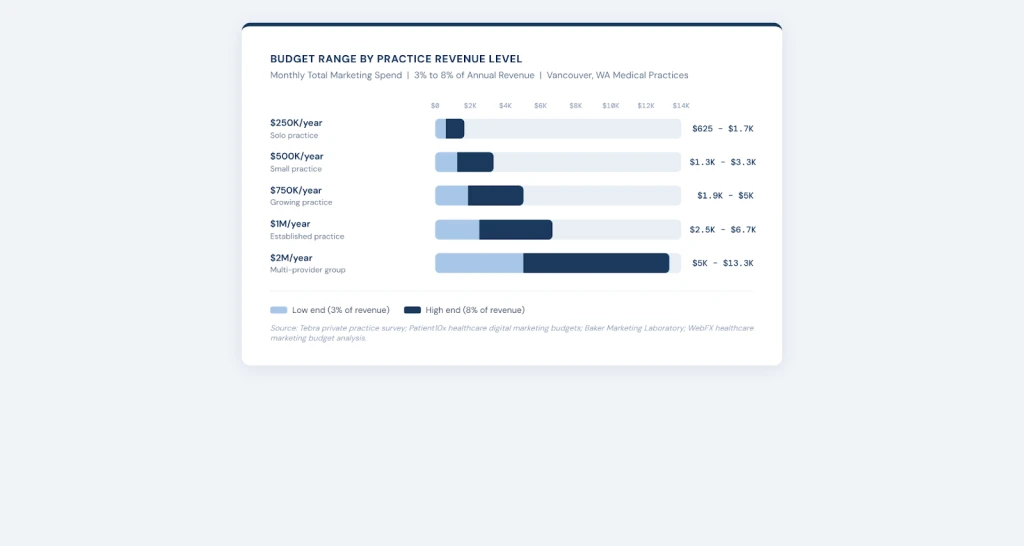
| ual Rvenue | Monthly Budget | Budget Range at 3-8% of Revenue (20 blocks = max scale) |
| $20K/year (solo practice) | $625-$1,667% | |
| $500K/year (small practice) | $1,250-$3,333% | |
| $750K/year (growing practice) | $1,875-$5,000% | |
| $1M/year (established practice) | $2,500-$6,667% | |
| $2M/year (multi-provider group) | $5,000-$13,333% |
Medical Practice Website: The Foundation Cost
Before any marketing channel can work, your practice needs a website that converts visitors into patients. A medical website is not a brochure. It is the first place most new patients evaluate your practice, confirm your credentials, and decide whether to call. In Vancouver’s competitive healthcare market, a template-based site that looks dated or loads slowly loses patients before they ever pick up the phone.
According to Flamingo Agency’s medical website design cost guide, small practice websites typically cost $4,000 to $8,000 for a professionally built, conversion-focused site without complex integrations. PatientGain’s healthcare website pricing data puts reputable agencies in the $5,000 to $10,000 range for a single-location practice. Practices needing patient portal integration, EHR connections, or advanced scheduling can expect $10,000 to $25,000 or more.
Medical Practice Website Cost Breakdown (Vancouver, WA Small Practice)
| Website Component | Budget Option | Professional Option | Notes for Vancouver Practices |
| Custom design and development | $2,000-$5,000 | $5,000-$15,000 | Higher end justified for competitive specialties; budget options often lack HIPAA compliance and conversion optimization |
| Content writing (service pages, bio, about) | $500-$1,500 | $1,500-$4,000 | Vancouver-specific content (neighborhoods, conditions relevant to local demographics) helps local SEO |
| HIPAA compliance configuration | $500-$1,500 | $1,500-$3,000 | Non-negotiable; any form collecting patient data requires compliant handling |
| Online booking integration | $300-$800 | $800-$2,000 | Practices with easy online booking convert significantly more mobile searchers |
| Hosting and security (annual) | $300-$600/yr | $600-$1,500/yr | Managed medical hosting with SSL, backups, and uptime monitoring |
| Monthly maintenance and updates | $75-$150/mo | $150-$300/mo | Includes security patches, plugin updates, content edits; neglected sites lose rankings |
| Typical total build cost (small practice) | $3,500-$7,000 | $7,000-$20,000 | Source: PatientGain, Flamingo Agency, Patient10x website cost analyses |
| The website is not optional spending, it is foundational spending: Every other marketing channel, whether Google Ads, SEO, or social media, sends people to your website before they book. A site that loads slowly, looks unprofessional, or buries the booking button eliminates a significant percentage of the patients you paid to attract. Patient10x’s website development ROI analysis shows that professional website optimization typically improves marketing ROI by 40 to 60% across all channels by converting more of the traffic each channel generates. |
Medical Practice SEO Costs in Vancouver, WA
Search engine optimization for medical practices is the ongoing process of ranking your website in Google organic search results and the Google Maps three-pack for the searches your prospective patients actually use. It is the highest long-term ROI channel for most practices, but it requires consistent monthly investment and produces results over months, not days.
Per WebFX’s healthcare SEO pricing guide, local healthcare SEO costs $300 to $2,000 per month for foundational local work, and $1,500 to $5,000 per month for comprehensive ongoing SEO services from a reputable agency. Intrepy Healthcare Marketing’s 2025 medical SEO agency rankings note that solo practices typically invest $750 to $1,500 per month, while multi-provider groups or competitive-market practices run $3,000 to $8,000 per month. Most practices begin seeing organic visibility gains within 90 to 120 days, with stronger growth after 6 to 12 months.
Medical SEO Pricing Tiers for Vancouver, WA Practices
| Service Tier | Monthly Cost | What Is Included and When It Makes Sense |
| Basic Local SEO | $300-$800/mo | GBP setup and optimization, basic citation management, NAP consistency audit. Good for solo practices in lower-competition specialties like internal medicine or general practice in suburban Clark County zip codes. |
| Small-Scale Local SEO | $800-$1,500/mo | GBP management, citation building, monthly content, basic link building, review management assistance. Suitable for single-location primary care, pediatrics, or physical therapy practices building initial online visibility. |
| Comprehensive Local SEO | $1,500-$3,000/mo | Full GBP management, treatment-specific service pages, ongoing blog content, local link building, review automation, monthly reporting. Right for most Vancouver specialty practices (dermatology, orthopedics, urgent care, OB/GYN) competing actively for local search traffic. |
| Competitive / Multi-Specialty SEO | $3,000-$5,000+/mo | Multiple service-line pages, aggressive content strategy, technical SEO, competitive backlink analysis, schema markup, E-E-A-T optimization. Necessary for high-competition specialties (plastic surgery, cosmetic dermatology) or multi-location practices serving Clark County and the Portland metro. |
| Project-Based (one-time) | $5,000-$30,000 | Technical SEO audit, website restructure, content strategy buildout, GBP setup. Useful for launching a new practice or major website rebuild; best paired with an ongoing retainer. |
Sources: WebFX healthcare SEO pricing guide; Intrepy Healthcare Marketing 2025 best medical SEO agencies; Search Business Group healthcare SEO pricing; DAGMAR healthcare SEO pricing.
Realistic SEO Results Timeline for Vancouver Medical Practices
| Phase | Timeframe | Expected Results |
| Foundation | Month 1-2 | Technical audit, GBP verification, initial citations, keyword mapping. No visible ranking improvement yet. This is groundwork. |
| Early Signals | Month 2-4 | GBP begins appearing for lower-competition searches. First impressions and clicks from Maps. No significant organic website traffic yet. |
| Traction | Month 4-8 | Organic rankings appear for service and location terms. Website traffic increases. First organic appointment inquiries arrive. |
| Growth | Month 8-14 | Consistent page 1 rankings for primary Vancouver treatment terms. Steady monthly organic leads. SEO cost per patient starts dropping. |
| Compounding | Month 14+ | Traffic grows with minimal additional spend as authority builds. Vancouver content creates a defensible local presence Portland competitors cannot easily outbid. |
Google Ads Costs for Medical Practices in Vancouver, WA
Google Ads is the fastest way to acquire new patients. When campaigns are set up correctly, a Vancouver practice can appear at the top of search results for high-intent terms like ‘urgent care near me’ or ‘dermatologist Vancouver WA’ within days of launch. The trade-off is that every click costs money, every patient costs money, and the moment you pause the campaign, the bookings stop.
Healthcare CPC rates sit in the moderate range compared to legal or insurance. According to LocaliQ’s healthcare search advertising benchmarks (covering 3,542 US campaigns through September 2025), most healthcare subcategories see CPC between $3 and $7 per click. Patient10x’s Google Ads cost analysis for medical practices shows primary care at $3 to $12 per click and specialty terms like dermatology reaching $8 to $25 per click. Plastic surgery and cosmetic surgery keywords can hit $15 to $50 per click in competitive markets.
Google Ads CPC and Monthly Budget by Medical Specialty (2025-2026)
| Specialty | CPC Range | Suggested Monthly Ad Spend | Vancouver-Specific Notes |
| Primary Care / Family Medicine | $3-$12 | $800-$2,000 | Lower competition; Google Ads most useful for accepting new patients and specific services like same-day appointments or weight management |
| Urgent Care / Walk-In | $4-$15 | $1,500-$4,000 | High intent and time-sensitive; mobile-first campaigns targeting Clark County zip codes produce strong results; Portland overlap increases CPCs |
| Dermatology (medical) | $8-$20 | $2,000-$5,000 | Highly competitive; cosmetic dermatology keywords cost more than medical; SEO essential alongside ads in this specialty |
| Orthopedics / Sports Medicine | $8-$20 | $2,000-$5,000 | Research-intensive decisions; ads capture immediate need (injury, pain); content SEO supports longer decision-making patients |
| OB/GYN / Women’s Health | $5-$15 | $1,500-$3,500 | Strong local intent; ‘OB/GYN Vancouver WA’ and related terms produce well with proper targeting and landing pages |
| Mental Health / Psychiatry | $6-$18 | $1,500-$4,000 | CPCs rose 42% in 2024 per LocaliQ; fastest-growing ad category in healthcare; high demand post-pandemic in Clark County |
| Plastic / Cosmetic Surgery | $15-$50+ | $5,000-$15,000+ | Highest CPCs in healthcare outside legal; strong patient lifetime value justifies cost; landing page and offer quality are critical |
| Physical Therapy / Rehab | $4-$12 | $1,000-$2,500 | Insurance referral-driven in many cases; ads most useful for cash-pay services and self-referral patients |
| Pediatrics | $3-$10 | $800-$2,000 | Lower CPC; strong local loyalty; Google Ads useful for new practice launch or accepting new patients after capacity opens |
| Weight Loss / GLP-1 / Semaglutide | $8-$20 | $2,000-$5,000+ | Fastest-growing category 2024-2025; extremely high current demand; ads capture intent while SEO builds authority |
Sources: LocaliQ healthcare search advertising benchmarks 2025; Patient10x Google Ads cost analysis by specialty; Promodo healthcare digital marketing benchmarks 2026.
| The Vancouver market CPC reality: Vancouver sits in a Portland metro overlap zone. Portland-area practices running broad location targeting often include Clark County zip codes in their campaigns, which pushes local CPCs higher than markets of comparable population. Genius Marketing’s Vancouver doctors marketing page identifies this directly: practices across Clark County face ‘rising competition, informed patients, and changing search behavior.’ Precise zip code and radius targeting within Clark County boundaries is essential to avoid paying for Portland ad competition in your local campaigns. |
Online Reputation Management Costs for Vancouver Medical Practices
Reputation management is consistently ranked among the most effective yet most underinvested marketing activities for independent medical practices. Tebra’s private practice marketing survey found that 37% of practices use reputation management as part of their marketing, ranked it the second most successful tactic, and yet 38% spend less than $1,000 per year managing their online reputation. That is less than $85 per month to manage one of the most powerful patient acquisition signals in existence.
Why does this matter for Vancouver practices specifically? Over 90% of patients consult reviews when searching for a doctor, per Healthgrades research cited by Rosica Communications’ 2026 healthcare marketing strategy report. A practice with 4.8 stars and 150 reviews captures patients who have already decided to trust the provider before they ever call. A practice with 3.9 stars and 20 reviews loses those patients regardless of SEO rank or ad spend.
Reputation Management Cost Tiers for Medical Practices
| Tier | Monthly Cost | What Is Included |
| DIY / Minimal | $0-$100/mo | Manual review monitoring, occasional responses. Typically means reviews accumulate unanswered and requesting reviews depends on staff remembering to ask. Under-invested by most practices. |
| Basic Review Management | $100-$300/mo | Automated review request texts/emails post-appointment, manual response to reviews, monthly reporting. Covers Google and Healthgrades. Good starting point for most solo practices. |
| Full Reputation Management | $300-$600/mo | Multi-platform management (Google, Healthgrades, Zocdoc, Yelp), AI-assisted review responses, negative review triage, proactive survey campaigns, monthly review velocity reporting. |
| Enterprise / Multi-Location | $600-$1,500+/mo | All of the above across multiple locations, provider-level reputation tracking, competitive benchmarking, integration with practice management software for automated triggers. |

Social Media and Content Marketing Costs
Social media for medical practices serves a different role than it does for consumer brands. Platforms like Facebook and Instagram are not typically primary patient acquisition channels for most medical specialties. They build trust, keep your practice top of mind with existing patients, and provide social proof for prospective patients who visit your profile after finding you on Google. For certain specialties like cosmetic surgery, dermatology, and aesthetics, visual-heavy social content is a stronger driver of new patient interest.
Content marketing (blog posts, FAQs, educational articles) sits closer to SEO in function. Every well-optimized article on your website answering a patient question is a permanent asset that generates organic traffic with no ongoing media cost. Baker Marketing’s medical practice budget breakdown recommends allocating 20 to 25% of the marketing budget to SEO and website content, 20 to 30% to paid ads, and 10 to 15% to social media and content. For most Vancouver practices, that means social media is a secondary investment behind website, SEO, and reputation management.
Social Media and Content Marketing Cost Guide for Medical Practices
| Channel / Activity | Monthly Cost Range | What to Expect and When It Makes Sense |
| Social media management (agency) | $500-$2,000/mo | 2-4 posts per week across Facebook and Instagram, content calendar, basic community management. Most valuable for visual specialties (cosmetic, dermatology, aesthetics) where before/after content drives decisions. |
| Social media management (in-house) | $0-$500/mo (tools) | Staff time plus scheduling tools like Buffer or Hootsuite. Effective for practices with a team member who is comfortable creating content, but consistency is the challenge. |
| Facebook / Meta paid ads | $500-$2,500/mo | Demand generation for elective and wellness services; retargeting website visitors. Less effective for emergency and insurance-driven specialties; better for cosmetic, weight loss, and wellness services. |
| Blog content creation (agency-written) | $300-$1,500/mo | 2-4 articles per month covering patient questions, conditions, procedures. Every article is a permanent SEO asset. Vancouver-specific and condition-specific content ranks and converts well over time. |
| Email / SMS patient marketing | $100-$400/mo | Monthly newsletters, appointment recall, post-visit follow-up. One of the highest-ROI retention channels; keeps existing patients engaged and reduces churn. Requires HIPAA-compliant platform. |
| Video content production | $300-$2,000/mo | Short provider intro videos, procedure explainers, patient FAQ videos. Video content is increasingly prioritized by Google; builds trust efficiently for patients researching providers. |
Complete Monthly Marketing Budget Models for Vancouver Medical Practices
Below are four realistic monthly budget models calibrated for Vancouver, WA practices at different stages and specialties. These are starting frameworks, not fixed formulas. Adjust based on your specialty competitiveness, growth goals, and current digital footprint.
Four Monthly Budget Models: Vancouver Medical Practices (2025-2026)
| Budget Line Item | Solo / New Practice | Small Established Practice | Competitive Specialty | Multi-Location / Growth |
| Website maintenance and hosting | $100-$200 | $150-$300 | $200-$400 | $400-$800 |
| Local SEO (GBP + content + citations) | $750-$1,200 | $1,200-$2,000 | $2,000-$3,500 | $3,500-$6,000 |
| Google Ads (ad spend + management) | $0-$800 | $1,000-$2,500 | $2,500-$6,000 | $5,000-$12,000 |
| Reputation management | $100-$200 | $200-$400 | $300-$600 | $600-$1,500 |
| Social media and content | $0-$300 | $300-$800 | $500-$1,500 | $1,000-$2,500 |
| Email / SMS marketing | $0-$100 | $100-$300 | $200-$400 | $400-$800 |
| TOTAL MONTHLY ESTIMATE | $950-$2,800 | $2,950-$6,300 | $5,700-$12,400 | $10,900-$23,600 |
| How to read these budgets: ‘Solo / New Practice’ assumes a single provider with no current digital presence, prioritizing GBP optimization and foundational SEO while holding off on paid ads until the website is ready to convert traffic. ‘Competitive Specialty’ (dermatology, plastics, cosmetic) reflects the higher CPC reality and content investment required to compete in those markets. ‘Multi-Location / Growth’ covers 2 to 4 Clark County locations actively acquiring new patients. All figures exclude one-time website build costs. |
How to Allocate Your Marketing Budget Across Channels
The channel mix within your total budget matters as much as the total amount. Spending $3,000 per month entirely on Google Ads with no SEO foundation means every patient costs you money in perpetuity and you build no owned asset. Spending $3,000 entirely on SEO produces no patients for the first several months while the organic rankings build. The right allocation depends on your stage.
Recommended Channel Budget Split by Practice Stage (Vancouver, WA)
| Practice Stage | Website / Maint. | SEO / GBP | Google Ads | Reputation Mgmt. | Social / Content |
| New practice (0-6 months) | 25% | 25% | 35% | 10% | 5% |
| Growing practice (6-18 months) | 15% | 35% | 30% | 12% | 8% |
| Established practice (18+ months) | 10% | 45% | 25% | 12% | 8% |
| Dominant local practice (3+ years) | 8% | 55% | 18% | 12% | 7% |
| Cosmetic / elective-heavy specialty | 10% | 30% | 30% | 10% | 20% |
Sources: Baker Marketing Laboratory medical practice budget allocation guide; Patient10x complete healthcare marketing budget guide; Tebra healthcare marketing budget template guide.
What Should You Expect in Return? ROI Benchmarks for Medical Practice Marketing
Marketing ROI for medical practices is measured by patient acquisition cost relative to patient lifetime value. PatientGain’s ROI guidance for medical practices recommends targeting a 3x to 5x return on advertising spend, meaning for every $100 spent, you should expect $300 to $500 in patient revenue. At a $132 average new patient acquisition cost (per the American Med Spa Association’s 2026 data) and an average visit value well above that figure for most specialties, properly managed marketing consistently meets this threshold.
Patient Acquisition Cost vs. Patient Value by Specialty
| Specialty | Typical Acq. Cost | Avg. Annual Patient Value | ROI Implication |
| Primary Care | $60-$150 | $800-$1,500+ | Long-term patient relationships mean a single acquired patient can be worth $5,000+ over their relationship with the practice. Low acquisition cost, high lifetime value. |
| Urgent Care (per visit) | $30-$100 | $150-$400/visit | High volume, lower per-patient value. Cost per acquisition must stay low; strong GBP visibility and walk-in convenience are primary drivers. |
| Dermatology | $100-$300 | $1,200-$3,000+/yr | High repeat visit frequency and expanding cosmetic offerings increase patient value significantly. Marketing investment easily justified. |
| Orthopedics / Surgery | $150-$400 | $2,000-$10,000+ | High procedure value means even expensive CPCs and acquisitions produce strong ROI. Attribution is important because decisions take weeks to months. |
| Mental Health / Therapy | $80-$200 | $1,500-$5,000+/yr | Long-term patient relationships with weekly or bi-weekly sessions make each acquired patient highly valuable. CPCs rising but still justified. |
| Physical Therapy | $50-$150 | $600-$2,000/episode | Episode-of-care model means retention work and referrals are as important as new patient acquisition. |
| Cosmetic Surgery / Aesthetics | $200-$600 | $3,000-$15,000+ | Highest procedure values in outpatient medicine. High CPCs and acquisition costs are justified by very high patient lifetime value. |
The Most Common Medical Practice Marketing Budget Mistakes in Vancouver, WA
| Mistake | Why It Costs You Patients and What to Do Instead |
| Underspending across the board | 62% of practices spend 1 to 5% of revenue on marketing per Tebra, but successful growth-focused practices invest 6 to 12%. In a growing market like Clark County with Portland competition, underspending means slower patient growth and giving ground to competitors who invest more consistently. |
| No website before running paid ads | Sending Google Ads traffic to a slow, outdated, or poorly converting website wastes the entire ad budget. Every click that does not become an appointment is money lost. Build and optimize the website first; then run ads. |
| Ignoring the Google Business Profile | The GBP is the highest-ROI free asset in medical practice marketing. It drives Maps visibility, displays reviews, shows hours and services, and lets patients book directly. An unoptimized or inactive GBP loses patients before they ever reach your website. |
| Spending less than $1,000 per year on reputation management | Per Tebra’s survey, 38% of practices spend this little on reputation management, yet three in four patients say reviews are extremely or very important in their choice of provider. Systematic review generation and response costs a few hundred dollars per month and has outsized impact on new patient conversion. |
| Running ads without specialty-specific landing pages | Sending paid traffic to the practice homepage instead of a procedure-specific landing page cuts conversion rates significantly. Each service campaign needs its own page with a relevant headline, clear call to action, and booking option. |
| Choosing one channel and ignoring others | Practices that rely entirely on referrals, or entirely on ads, or entirely on word of mouth create fragile patient pipelines. The practices with the most stable and growing patient census in Clark County use SEO, GBP, reviews, and targeted ads together as a system. |
| Not tracking cost per acquired patient by channel | Without attribution tracking (call tracking, UTM parameters, intake source questions), you cannot know which marketing investments produce patients and which burn money. Every Vancouver practice should track source at the time of scheduling, not as an afterthought. |
| Get a Free Medical Practice Marketing Audit for Your Vancouver, WA Practice Genius Marketing works with medical practices across Vancouver, WA and Clark County. We understand the Portland overlap challenge, the local competitive landscape across specialties, and how to build marketing systems that produce consistent, trackable new patient acquisition at a cost that makes sense for your practice size and revenue.Whether you need a website that actually converts, an SEO strategy built around Vancouver-specific patient searches, a Google Ads campaign calibrated to your specialty’s CPCs, or a reputation management system that generates reviews automatically, we start with your numbers and show you where every marketing dollar goes before you spend it.Call (360) 519-5100 or visit [email protected] to schedule your free audit today. |
Frequently Asked Questions
How much should a new medical practice in Vancouver, WA spend on marketing in the first year?
New practices without an established patient base should plan on investing 10 to 15% of projected first-year revenue on marketing to build awareness and fill the schedule. In practical terms, that often means $2,000 to $5,000 per month across website build, GBP setup, SEO foundation, and targeted Google Ads. The website should be built first, then ads launched, then SEO content built consistently over the first 12 months as organic rankings develop.
What is the single highest-ROI marketing activity for most Vancouver medical practices?
For most practices, fully optimizing the Google Business Profile costs little to nothing and consistently produces the fastest return. A complete, photo-rich, regularly updated GBP with strong review velocity directly drives Maps visibility and patient calls. After the GBP, systematic reputation management (getting more Google reviews) and local SEO content specific to Vancouver and Clark County deliver the strongest compound returns at the lowest ongoing cost.
How long before marketing investment produces measurable results?
Google Ads can produce appointment inquiries within a week of launch when campaigns are properly set up. GBP optimization typically shows increased calls and map appearances within 30 to 60 days. Organic SEO takes 90 to 120 days for initial visibility gains and 6 to 12 months for consistent, meaningful organic patient flow. Practices should plan their budget timeline accordingly, using paid ads to fill near-term gaps while SEO builds the long-term asset.
Is it worth hiring a marketing agency, or can a practice handle this in-house?
Most practices do not have the staff bandwidth or technical expertise to manage SEO, paid campaigns, reputation management, and content simultaneously at a competitive level. An experienced healthcare marketing agency typically pays for itself through improved conversion rates, lower cost per patient, and avoiding the mistakes that waste budget. The key is finding an agency with verifiable healthcare marketing experience, not a generalist agency that also happens to take medical clients.
Does the Portland market affect marketing costs for Vancouver, WA practices?
Yes, meaningfully. Portland-area practices running geographic-targeted Google Ads campaigns frequently include Clark County zip codes in their targeting, which increases CPCs for Vancouver practices bidding on the same keywords. At the same time, a Vancouver practice with strong local SEO, a well-optimized GBP, and Vancouver-specific content has a geographic relevance advantage in local search results that Portland practices cannot overcome simply by spending more on ads. This is why investing in local SEO alongside paid advertising is especially important for Clark County practices.
What does Genius Marketing charge for medical practice marketing services in Vancouver, WA?
Every engagement is scoped based on your specialty, competitive landscape, current digital footprint, and growth goals. We offer a free practice marketing audit that includes a GBP review, competitive analysis, and channel-specific recommendations before any engagement begins. Contact us at (360) 519-5100 or visit [email protected] to schedule yours.