
Many website owners expect traffic to grow on its own once the site goes live, but it rarely works that way. You might have valuable content, a smooth layout, and a service people actually need, yet the numbers stay flat. This usually happens not because the site is weak, but because people cannot find it in the first place. Search engines need clear signals to understand what your pages offer and who they should send your way.
This is where search engine optimization plays a key role. It helps your pages appear for the searches your audience is already typing, supports trust, and guides visitors to the information or solutions they want. When you follow the right steps, SEO marketing becomes a steady source of traffic that grows over time, rather than relying on ads or one-time promotions.
In this SEO guide, you will learn how search engines work, what helps a page rise in the results, and how to build a strong foundation that brings consistent organic traffic. The goal is to help you understand SEO in a simple, practical way you can use right away.
How Search Engines Work: The Mechanics of the Web
Search engines like Google and Bing act as massive, automated librarians, organizing information to deliver the most relevant answer instantly. They work through three main steps:
1. Crawling: Search engines use bots, like Googlebot, to discover web pages. Starting with known URLs and sitemaps, these bots follow links to find new content. Links are essential, as isolated pages remain undiscovered.
2. Indexing: Once a page is found, the bot analyzes its content, media, structure, and language. Pages meeting quality standards are stored in the Index, a vast database of web content. Not all live pages are indexed, so a site must be checked using site:yourdomain.com to confirm its presence.
3. Ranking: When a user searches, the engine scans the Index for relevant pages and sorts them using its algorithm, which considers relevance, authority, user experience, and freshness. User behavior, like clicking back quickly or staying on a page, influences ranking accuracy.
Understanding these mechanics is essential to ensure your content is discoverable, indexed, and positioned to solve users’ queries effectively.
AI in SEO: The Shift to Generative Search
The search industry is currently undergoing its most significant shift in twenty years. We are moving from “retrieval” (finding a list of links) to “generation” (creating a direct answer).
SGE: Search Generative Experience
Google is rolling out the Search Generative Experience (SGE). Instead of just seeing ten blue links, users now see an AI-generated snapshot at the top of the page. This snapshot aggregates information from multiple sources to answer the query directly.
For example, if you search “How do I market my plumbing business?”, the AI might generate a 12-week marketing plan, a list of local advertising ideas, and a checklist for optimizing your website for leads right on the search page. It then provides links to the sources
How AI Models Analyze Content
Traditional algorithms looked for keywords. Large Language Models (LLMs) and AI systems look for context and consensus.
- Semantic Understanding: AI doesn’t just match strings of characters. It understands that “cheap,” “affordable,” and “budget-friendly” mean the same thing in a shopping context. It understands that “bank” means something different in “river bank” versus “bank account.”
- Entity Recognition: AI views the web as a map of “entities” (businesses, services, tools, and concepts) and their relationships. It knows that “HVAC Marketing” is an entity related to “lead generation,” “local advertising,” “SEO,” and “home heating and cooling services.”
- Consensus Checking: For factual queries, AI models look for consensus across authoritative sources. If ten trusted medical sites say a symptom indicates the flu, and your site says it means a broken leg, the AI will likely ignore your content.
GEO: Generative Engine Optimization
This new reality requires a new optimization strategy called Generative Engine Optimization (GEO). The goal here is to be cited by the AI.
To optimize for GEO:
- Structure is King: Use clear headings, bullet points, and tables. AI models ingest structured data much more easily than walls of text.
- Cite Your Sources: Linking to other authoritative data within your content helps the AI verify your claims. See examples from Search Engine Land and Backlinko.
- Be Direct: Answering the user’s core question in the first 2-3 sentences of your content (the “inverted pyramid” style of writing) increases the likelihood of being picked up for a snippet.
Ranking Factors: The Signals That Matter
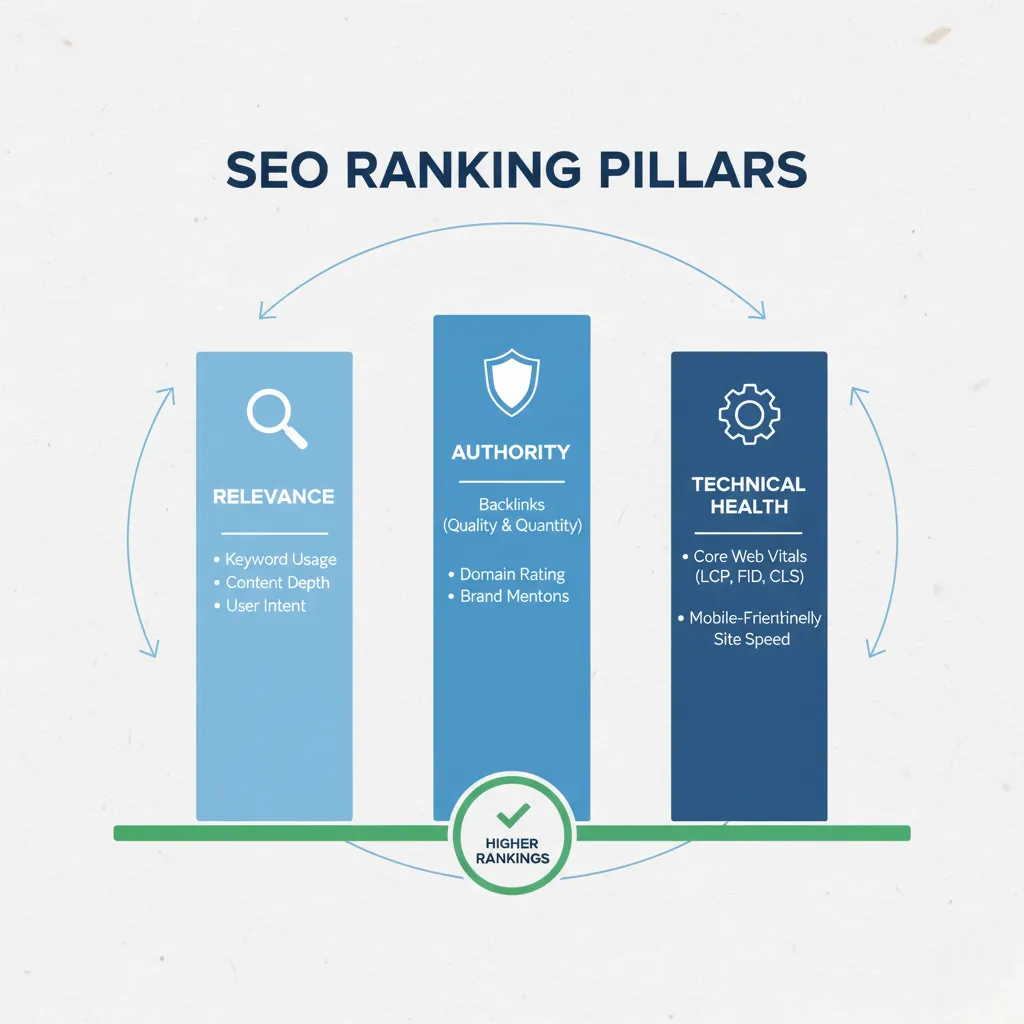
While there are over 200 ranking factors, obsessing over all of them is a waste of resources. You need to focus on the signals that move the needle. These can be categorized into three pillars: Relevance, Authority, and Technical Health.
1. Relevance Signals
Does your content actually satisfy the user’s intent?
- Keyword Usage: The target phrase should appear in critical areas like the title tag, main header (H1), and naturally throughout the body.
- Content Depth: Longer content often ranks better, not because of word count, but because it covers a topic thoroughly. A 2,000-word guide usually answers more user questions than a 300-word summary.
- Freshness: For topics that change often (like SEO or news), updated content is preferred.
2. Authority Signals
Can the search engine trust you?
- Backlinks: This is still one of the strongest signals. A link from a high-authority site (like the New York Times or a university domain) acts as a massive vote of confidence.
- Domain Age and History: Older domains with a clean history generally perform better than brand-new ones.
- Brand Signals: Mentions of your brand across the web, even without links, help establish you as a real entity.
3. Technical Signals (Page Experience)
Is your website annoying to use?
- Core Web Vitals:
These are specific metrics Google uses to measure speed and stability.
- LCP (Largest Contentful Paint): How fast does the main content load? (Target: under 2.5 seconds)
- INP (Interaction to Next Paint): How quickly does the page respond when you click a button? (Target: under 200 milliseconds)
- CLS (Cumulative Layout Shift): Do elements jump around while loading? (Target: 0.1 or less)
- Mobile-Friendliness:
Since 2019, Google has used Mobile-First Indexing. They primarily look at the mobile version of your site to decide where you rank. If your desktop site is beautiful but your mobile site is broken, your rankings will tank.
- HTTPS: Security is a prerequisite. If your site still uses HTTP, browsers will flag it as “Not Secure,” hurting user trust and rankings.
Keyword Research: The Strategy Phase
Keyword research is the foundation of SEO. If you skip this, or do it poorly, everything else you do is guesswork. It is the process of understanding the language your customers use.
Many roofing businesses make the mistake of guessing. They think, “I install roofs, so I want to rank for ‘roofing’.” The problem is that ‘roofing’ is too broad. You are competing with big national companies and established local contractors. You will not win that fight. You need to find the right-fit keywords: specific enough to show strong intent, but popular enough to attract homeowners looking for roofing services.
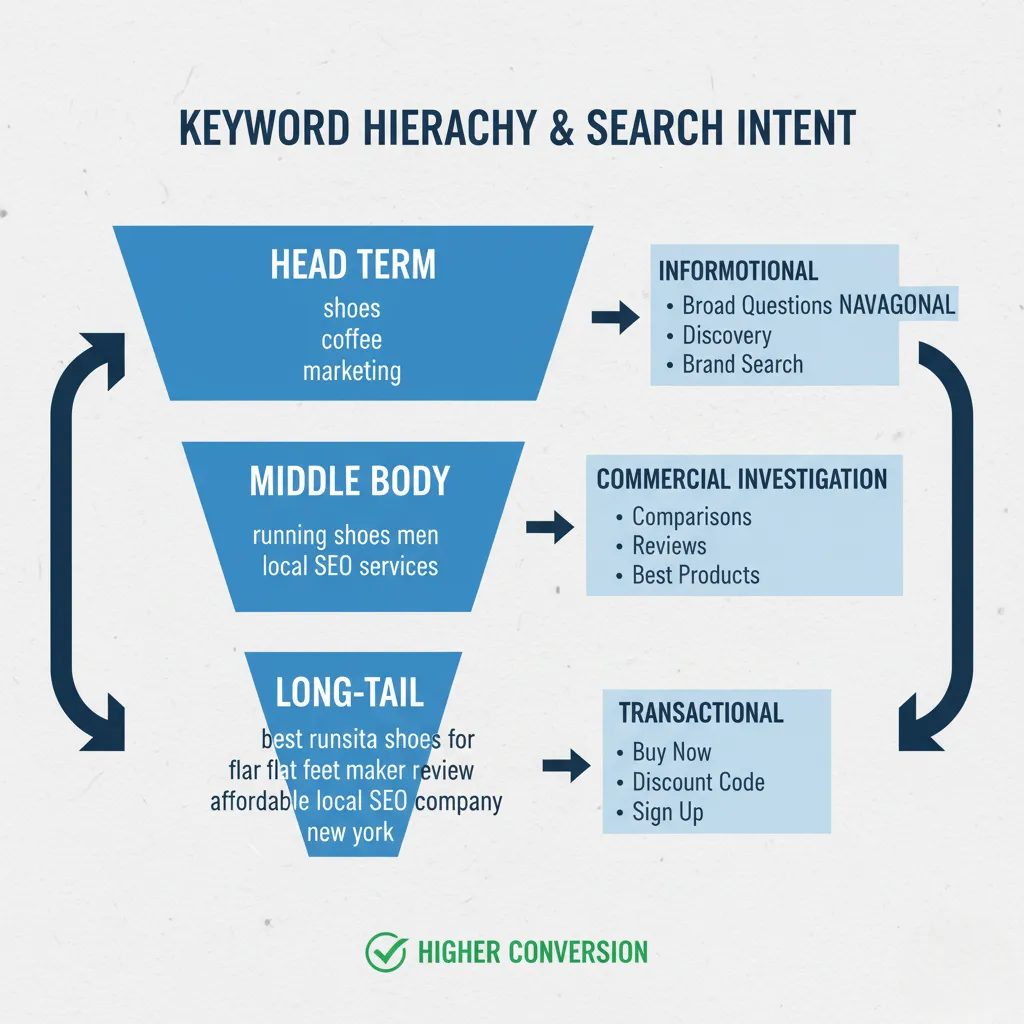
The Four Pillars of Search Intent
Keywords reflect the intentions behind what users search for, helping businesses create content that meets their audience’s needs.
1. Informational Intent
Users want to learn or solve a problem.
- Restoration Marketing: “How to prevent mold after water damage”
- Med Spa Marketing: “Benefits of microneedling”
- Medical Clinics Marketing: “Symptoms of type 2 diabetes”
- Cleaning Marketing: “How to remove carpet stains”
Content: Blog posts, guides, explainer videos.
2. Navigational Intent
Users seek a specific site or business.
- Restoration Marketing: “ServPro contact”
- Med Spa Marketing: “Glow Med Spa hours”
Content: Clear site structure, contact pages.
3. Commercial Investigation
Users compare services or products.
- Med Spa Marketing: “CoolSculpting vs SculpSure”
Content: Comparison tables, case studies.
4. Transactional Intent
Users are ready to buy or book.
- Cleaning Marketing: “Book carpet cleaning online”
Content: Service pages, landing pages with strong calls-to-action.
This framework ensures marketing aligns with user intent at every stage.
The Long-Tail Strategy
The most brilliant strategy for most businesses is to target Long-Tail Keywords. These are phrases containing three or more words.
- Head Term: “Insurance” (High volume, low intent, massive competition)
- Middle Body: “Health Insurance Plans” (Medium volume, medium intent, high competition)
- Long-Tail: “Affordable family health insurance for self-employed in Texas” (Lower volume, incredibly high intent, lower competition)
A person searching for that long-tail phrase has likely already done their research. They know exactly what they want. If you put that exact product in front of them, they are highly likely to buy.
Analyzing Keyword Difficulty (KD)
Most SEO tools assign a “Keyword Difficulty” score from 0 to 100. This estimates how hard it will be to rank on the first page.
- New Sites: Target keywords with KD 0-30.
- Growing Sites: Target KD 30-60.
- Established Authorities: Target KD 60+.
Do not waste time trying to rank for a KD 90 keyword if your site is brand new. Build momentum with easier wins first.
On-Page SEO Essentials
On-page SEO involves optimizing the elements you control directly on your webpages. It is about speaking the search engine’s language so it can categorize your content correctly.
1. Title Tags: The Billboard
The Title Tag is the blue link that appears in search results. It is the single most important on-page factor.
- Format: Primary Keyword | Secondary Keyword | Brand Name
- Length: Keep it under 60 characters so it doesn’t get cut off.
- Best Practice: Make it clickable. Instead of just “Plumbing Services,” try “24/7 Emergency Plumbing Services in Seattle | Fast & Reliable.”
2. Meta Descriptions: The Sales Pitch
The meta description is the short paragraph under the title. It does not directly affect rankings, but it heavily influences Click-Through Rate (CTR).
- Goal: Summarize the page and entice the click.
- Length: Keep it under 155 characters.
- Content: Include a call to action. “Learn how to fix your sink in 5 minutes. Step-by-step guide with photos. Click to read now.”
3. Header Tags (H1, H2, H3)
Headers provide structure. Without them, your content is a wall of text that bots (and humans) struggle to parse.
- H1: The main headline. Use only one per page. It should closely match the Title Tag and include the main keyword.
- H2: The main chapters of your content.
- H3: Sub-sections within the chapters.
4. Internal Linking
An internal link connects Page A on your site to Page B.
- Navigation: They help users find related content, increasing the time they spend on your site.
- Authority Flow: They pass “link juice” from your strong pages to your weaker ones. If you have a powerful homepage, link to your new blog posts to give them a boost.
- Anchor Text: The clickable text matters. Avoid “click here.” Use descriptive text like “read our guide on link building strategies.”
5. URL Structure
Keep URLs short, clean, and descriptive.
- Bad: website.com/p=123?category=4
- Good: website.com/services/seo-audit. A clear URL tells the user and the bot exactly what to expect before the page even loads.
Technical SEO Overview
Technical SEO is the infrastructure that allows your content to rank. If your technical foundation is cracked, your content will never reach its potential.
Crawlability and Indexability
You need to ensure bots can actually access your content.
- Robots.txt: This is a text file in your root directory that gives instructions to bots. You can tell them to ignore certain areas, like your admin panel or cart. A common mistake is accidentally blocking the whole site with a Disallow: / command.
- XML Sitemap: This is a roadmap of your website. It lists every page you want indexed. You should submit this directly to Google Search Console.
- Status Codes: You need to monitor the server responses that your pages give.
- 200 OK: The page loaded correctly.
- 301 Redirect: The page has moved permanently. Use this when you delete a page but want to send traffic to a new version.
- 404 Not Found: The page is gone. Too many of these frustrate users and waste crawl budget.
- 500 Server Error: Your website is broken. Fix this immediately.
Schema Markup (Structured Data)
A schema is a standardized code vocabulary that helps search engines understand the content on your pages. It turns unstructured text into structured data.
- Local Business Schema: Tells Google your address, hours, and phone number.
- Product Schema: Provides Google with a product’s price, availability, and review rating.
- Article Schema: Helps blog posts appear in Google News.
Using schema can help you win “Rich Snippets” enhanced search results that include stars, images, or FAQs directly in the results page. Data from Search Engine Land suggests that pages with rich snippets see significantly higher click-through rates.
Duplicate Content and Canonical Tags
Search engines hate duplicate content. If you have the same text on three different URLs (e.g., a printer toner page accessible via “office supplies,” “toner,” and “brand” categories), Google doesn’t know which one to rank. The solution is the Canonical Tag. This is a line of code that tells Google, “This is the master version of the page. Ignore the duplicates and give all credit to this URL.”
Content Strategy: Topic Clusters and E-E-A-T
The days of writing 500-word blog posts about random topics are over. To become an authority, you need a structured content ecosystem.
The Topic Cluster Model
This strategy organizes your content into a hub-and-spoke model.
- Pillar Page (The Hub): A long, comprehensive guide (3,000+ words) covering a broad topic. For example, “The Ultimate Guide to Digital Marketing.”
- Cluster Content (The Spokes): Shorter, specific articles (800-1,500 words) that dive deep into sub-topics. Examples: “How to use Instagram Ads,” “Email Marketing Best Practices,” “SEO for Beginners.”
- Hyperlinking: Every cluster page links back to the pillar page, and the pillar page links out to the clusters.
This structure tells Google, “We are experts on Digital Marketing, and here is a library of connected content to prove it.”
E-E-A-T: The Quality Standard
Google uses a concept called E-E-A-T to evaluate content quality. It stands for Experience, Expertise, Authoritativeness, and Trustworthiness.
- Experience: Do you have first-hand knowledge? A guide on lawn care or garden design is more valuable if the author has actually completed the projects. Use phrases like “In our recent landscaping project…” or “When we installed this patio…”
- Expertise: Who created the content? For topics that affect safety, property value, or long-term maintenance, the author should be a verified landscaping professional. Include author bios with credentials, certifications, or years of experience in landscaping, garden design, or horticulture.
- Authoritativeness: Is your website a recognized leader? This is built over time through backlinks and brand mentions.
- Trustworthiness: Is the information accurate? Is the site secure? Do you have clear privacy policies and contact info?
AEO: Answer Engine Optimization
As discussed, AI is changing how we search. Optimizing for “Answer Engines” (like ChatGPT, Perplexity, and Google SGE) requires a shift in how you write.
The goal of AEO is to be the cited source.
Strategies for AEO
- Target “Question” Keywords: Focus on specific questions like “What is the difference between specific and broad match keywords?”
- The “Answer First” Format: Don’t bury the lead. Start your section with a direct, definition-style answer.
- Bad: “When thinking about keywords, there are many factors to consider…”
- Good: “Broad match keywords allow ads to show on searches related to your keyword, while specific match keywords require the user to type the exact phrase.”
- Use Lists and Steps: AI loves ordered lists. “Step 1, Step 2, Step 3.” It is easy for the bot to extract and present to the user.
- Keep it Factual: Avoid fluff and opinion. Stick to data, verified facts, and clear instructions.
Off-Page SEO: Building Authority
Off-page SEO is your reputation management. It tells Google what the rest of the world thinks of your website. The primary metric here is the Backlink.
The Logic of Link Building
A link is a vote. But in SEO, not all votes are equal.
- Relevance: A link from a site in your industry is worth far more than a random link. If you are a dentist, a link from a dental association is gold. A link from a video game blog is useless.
- Authority: A link from a site with high Domain Authority (like Forbes or TechCrunch) passes more value than a link from a small personal blog.
- Placement: A link inside the main body text is worth more than a link in the footer or sidebar.
Ethical Link Building Strategies
Never buy links. Google eventually catches link networks and penalizes the sites involved. Instead, earn them.
- The Skyscraper Technique: Find a piece of content in your industry that has a lot of links. Write something better, more up-to-date, better design, more data. Then, reach out to the people who linked to the old version and ask them to link to yours.
- Digital PR: Create newsworthy assets. Run a survey, analyze industry data, or create an infographic. Send a press release to industry journalists. If they use your data, they will link to you as the source.
- Help a Reporter Out (Connectively): Journalists often need expert quotes for their stories. Platforms like Connectively (formerly HARO) connect experts with reporters. If you provide a good quote, you get a mention and a link in a major publication.
- Broken Link Building: Find broken links on resource pages in your niche. Email the webmaster: “Hey, I noticed this link on your resources page is broken. I have a similar guide that might be a good replacement.” It is helpful for them and good for you.
Local SEO: Winning Your Neighborhood
If you have a physical storefront or serve a specific geographic area (like a plumber or contractor), Local SEO is vital. You are not competing with the whole world; you are competing with the businesses in your town.
The “Map Pack”
When you search “Italian restaurant near me,” Google shows a map with three businesses at the top. This is the “Map Pack” or “Local Pack.” Getting here is the holy grail of local SEO.
Google Business Profile (GBP)
Your GBP is your most important asset for local search.
- Claim and Verify: Ensure you own your listing.
- Complete Every Field: Add your business address, phone number, website, hours of operation, services offered (e.g., “gutter cleaning,” “pressure washing”), and the date your business was established.
- Categories: Choose the most specific primary category for your business. If you provide “Property Maintenance Services,” select that rather than a broader category like “Home Services” to ensure potential clients can find you easily.
- Photos: Upload high-quality photos of your exterior, interior, team, and work. Listings with photos get significantly more clicks.
- Reviews: This is a major ranking factor. Actively ask happy customers for reviews. Respond to every review, good or bad. It shows you are an active, caring business.
Citations and NAP Consistency
A “citation” is any mention of your business online. It usually includes your NAP (Name, Address, Phone). Consistency is critical. If your business is listed as “Genius Marketing” on one site and “Genius Mktg” on another, or if you have an old phone number floating around, Google gets confused. This confusion lowers your trust score. Use tools to audit and fix your citations across major directories like Yelp, Yellow Pages, and Bing Places.
Service Area Pages
If you serve multiple cities, create a unique page for each one.
- Do: Create a page for “Plumbing Services in Austin” with unique content about your Austin team, local projects, and reviews from Austin customers.
- Don’t: Create 50 pages where you just swap the city name in the text. This is “doorway page” spam.

SEO Tools: Your Tech Stack
You cannot do SEO blind. You need data to make decisions.
Essential Free Tools
- Google Search Console: The command center. It tells you exactly how Google sees your site, reports technical errors, and shows you which keywords are driving clicks.
- Google Analytics 4 (GA4): Tracks what users do after they land on your site. Use it to measure time on page, conversion rates, and bounce rates.
- Google Trends: Shows the popularity of search terms over time. Great for planning seasonal content.
Premium Tools (Worth the Investment)
- Semrush or Ahrefs: These are “all-in-one” suites. They allow you to spy on competitors, track thousands of keywords, audit your site for technical issues, and analyze backlink profiles.
- Screaming Frog SEO Spider: A desktop program that crawls your website just like Google does. It is indispensable for technical audits, finding broken links, and analyzing site architecture.
- Yoast SEO or RankMath: If you use WordPress, these plugins are essential. They handle the technical basics like sitemaps, meta tags, and schema markup automatically.
Measuring Success: KPIs That Matter
How do you know if your investment is paying off? You need to look beyond vanity metrics.
1. Organic Traffic
This is the raw number of visitors coming from search engines. Watch the trend line. Is it going up month over month?
2. Keyword Rankings
Track your main “money keywords.” Are you moving from page 5 to page 2? From page 2 to the top 3? Progress here leads to traffic later.
3. Organic Conversion Rate
Traffic is vanity; revenue is sanity. How many of those organic visitors are filling out your contact form, calling your phone, or buying a product? If you have high traffic but low conversions, you might be targeting the wrong keywords (wrong intent) or your landing page might be poor.
4. Click-Through Rate (CTR)
If you rank #1 but nobody clicks, it is a waste. A low CTR suggests your Title Tag or Meta Description is not compelling. Test the new copy to see if you can improve it.
5. Domain Authority (DA/DR)
While not a direct Google metric, scores like Moz’s DA or Ahrefs’ DR give you a good benchmark of your site’s overall link power compared to competitors.
Common SEO Myths
The industry is rife with misinformation. Let’s debunk the most persistent myths.
Myth: “SEO is a one-time setup.” Reality: SEO is a lifestyle, not an event. You are never “done.” Competitors are always publishing new content, and Google updates its algorithm thousands of times a year. If you stop, you drop.
Myth: “Longer content is always better.” Reality: Better content is better. If you can answer the user’s question perfectly in 500 words, do not write 3,000 words of fluff just to hit a length target. Google rewards utility, not word count.
Myth: “I need to submit my site to Google.” Reality: You haven’t needed to do this for a decade. Good crawlers will find you if you have links. Submitting a sitemap helps, but “submission services” are generally scams.
Myth: “Buying ads helps my organic rankings.” Reality: There is a strict “Chinese Wall” between Google Ads and Google Search. Spending millions on ads gives you zero direct benefit in organic rankings. However, the data you get from ads (which keywords convert) can inform your SEO strategy.
SEO Audit: The Health Check
Every 6 to 12 months, or whenever you see a drop in traffic, you should perform an audit.
The Strategic Audit Checklist:
- Crawl Analysis: Use Screaming Frog to crawl your site. Are there 404 errors? Redirect chains?
- Index Check: Go to Google Search Console > Pages. Look for “Discovered – currently not indexed” or “Crawled – currently not indexed.” These indicate quality issues.
- Speed Test: Run your top 5 templates through PageSpeed Insights. Address any red flags.
- Content Audit: Identify “zombie pages” that get zero traffic. Delete them, redirect them, or update them.
- Backlink Audit: Check for “toxic” links from spam sites. If you find a coordinated spam attack, use Google’s Disavow Tool to tell Google to ignore them.
Putting Your Strategy into Action
We have covered the landscape from the technical depths of server responses to the psychological nuances of user intent.
Here is your immediate action plan:
- Fix the Tech: Ensure your site is secure (HTTPS), mobile-friendly, and fast. Fix any broken links.
- Research: Build a keyword map based on user intent. Don’t just guess.
- Create: Build a “Pillar Page” for your core service. Make it the best resource on the internet for that topic.
- Optimize: Update your title tags and headers. Add internal links.
- Promote: Share your content. Reach out to partners for links.
- Wait and Watch: SEO takes time. It typically takes 3 to 6 months to see significant movement. Be patient and consistent.
The goal is not to be perfect tomorrow. The goal is to be better than you were yesterday.
Key Takeaways
- SEO is Holistic: It is a combination of technical health, content quality, and off-site authority. You cannot ignore one pillar and expect to succeed.
- Intent Over Keywords: Understanding why someone is searching is more important than the exact words they use.
- AI is Here: Optimize for answer engines by being structured, factual, and authoritative.
- Quality Wins: E-E-A-T is the standard. Demonstrate your expertise and experience in everything you publish.
- Patience Pays: SEO is a long-term, compound-interest investment for your business.
Need Expert Guidance?
The world of SEO is vast, and navigating it alone can be daunting. The rules change, the technology evolves, and the competition never sleeps. If you want to bypass the trial and error and implement a proven strategy that drives revenue, we are here to help.
At Genius Marketing, we don’t just chase rankings; we chase growth.
Call us today at (360) 519-5100 or email us to schedule your comprehensive SEO audit. Let’s build a roadmap to the top of the search results together.
Frequently Asked Questions
Why is SEO important for small businesses?
Search engine optimization helps your website rank higher in search results. For small businesses in plumbing, HVAC, landscaping, med spas, or cleaning, SEO is important because it attracts more local customers, increases calls or bookings, and helps you stand out from competitors in your area.
Can SEO help my business appear in local searches?
Yes. Local SEO focuses on making your business visible to people in your area searching for services like plumbing repairs, HVAC maintenance, landscaping, med spa treatments, or cleaning. This includes optimizing your Google Business Profile, local keywords, and customer reviews.
Do small businesses need backlinks to rank locally?
Yes. Links from local partners, community sites, or industry directories help search engines find your pages and boost your authority in local searches.
How does Google decide which local businesses appear first?
It considers relevance, proximity, and reputation. Complete profiles, good reviews, active engagement, and high-quality local content improve rankings.
Can SEO services increase my local leads and sales?
Yes. SEO services focus on improving your visibility in local searches, driving more potential customers to call, book, or visit your business. For small businesses, this often translates directly into higher leads and sales.
Sources
- Google Search Central – Official documentation on how Google crawls, indexes, and ranks web pages.
- Search Engine Land – Insights into how schema markup improves click-through rates and search visibility.
- Backlinko – A comprehensive analysis of the top ranking factors used by Google’s algorithm.
- Moz – Foundational data on SEO best practices and the evolution of search engine marketing.
- Ahrefs – Statistical data on search traffic, backlink importance, and keyword trends.